
 Log in
The Rise of AI Agents: Will Virtual Cards or Stablecoins Power the Future of Payments?
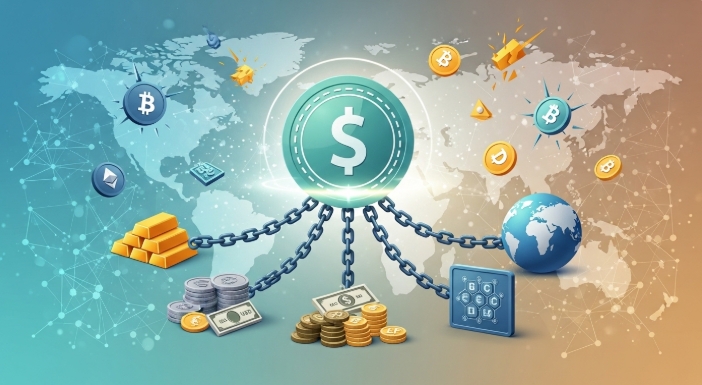
Stablecoin technology has become one of the most talked-about developments in digital finance, especially as new forms of automated commerce begin to emerge. At the same time, the rise of AI agents, software programs that can complete tasks and make decisions independently, is raising an important question: how will these systems handle payments?
An AI agent that books services, purchases software, or manages online advertising will need a reliable way to transact online. Two technologies are increasingly discussed as potential payment rails for this future: stablecoins and virtual cards.
While stablecoins offer programmable digital money, virtual cards already power millions of online transactions. Platforms like Bycard are part of this shift, providing virtual cards that can be issued instantly, controlled with spending limits, and used globally for digital payments, making them well suited for automated and AI-driven workflows.
- The Rise of AI Agents: Will Virtual Cards or Stablecoins Power the Future of Payments?
- Bycard Virtual Cards: The Other Payment Rail
- Why Bycard Virtual Cards Work Well for AI Agents
- Comparing Stablecoins and Virtual Cards
- Where Stablecoins May Have an Advantage
- Where Virtual Cards May Continue to Lead
- AI Agents and the Next Phase of Digital Commerce
Why AI Agents Are Changing Digital Payments
AI agents are designed to perform actions autonomously. Instead of waiting for instructions every time, they can operate continuously and execute tasks when certain conditions are met.
For example, an AI agent could:
- Purchase online advertising automatically
- Pay for software tools used by a business
- Renew subscriptions
- Book logistics or shipping services
- Manage digital asset transactions
As automation increases, payments will need to become machine-friendly.
Traditional payment systems were built around humans. They assume a person will approve transactions, authenticate payments, and review receipts. AI-driven systems, however, require payments that can operate programmatically and continuously.
This is where virtual cards and stablecoins enter the conversation.
The Expanding Stablecoin Market
Stablecoins have grown rapidly in the past few years, becoming a major segment of the digital asset economy.
Market Cap Growth
The global stablecoin market cap now exceeds $150 billion, depending on market conditions. Several major coins dominate this market:
- Tether (USDT)
- USD Coin (USDC)
- DAI
These coins are designed to maintain a steady value, typically pegged to the US dollar. Unlike many cryptocurrencies that experience significant price swings, stablecoins aim to stay close to $1 per coin.
This stability has made them attractive for payments, trading, and cross-border transfers.
Transaction Volume
Stablecoins now process trillions of dollars in annual transaction volume across blockchain networks. In many cases, their usage rivals or exceeds traditional digital payment platforms in certain regions.
This growth is partly driven by their ability to move money quickly and globally without relying on traditional banking infrastructure.
How Stablecoins Work in Practice
Stablecoins function as digital tokens issued on blockchain networks. Their value is typically backed by reserves such as cash, short-term treasury assets, or collateralized crypto holdings.
For users, this means they can send funds globally with only an internet connection.
Key Characteristics
Stablecoins offer several properties that are attractive for automated systems:
- 24/7 settlement without banking hours
- Programmable payments using smart contracts
- Global accessibility
- Fast transfers across borders
These characteristics align well with the needs of AI agents, which may operate continuously across multiple markets.
Stablecoin Use Cases Expanding
Stablecoins were initially popular within cryptocurrency trading, but their use cases have expanded significantly.
Cross-Border Payments
Businesses increasingly use stablecoins to send international payments. Transfers that might take several days through banks can settle in minutes on blockchain networks.
Digital Commerce
Online platforms are beginning to experiment with accepting stablecoin payments. This allows merchants to receive digital dollars without exposure to volatility.
Financial Infrastructure
Stablecoins are also used for:
- Decentralized finance applications
- Tokenized asset trading
- Treasury management for crypto companies
These growing use cases contribute to continued adoption.
Adoption Trends for Stablecoins
Stablecoin adoption has accelerated as more companies and institutions explore blockchain-based payment systems.
Several factors are driving this trend:
Demand for Digital Dollars
In regions with volatile currencies, stablecoins provide access to dollar-denominated value without requiring a foreign bank account.
Crypto Market Infrastructure
Many exchanges rely on stablecoins as their primary trading pairs, which increases daily transaction activity.
Institutional Interest
Financial institutions and fintech platforms are beginning to explore stablecoin integration for settlement and treasury operations.
Even large technology companies have reportedly evaluated stablecoins as potential payment infrastructure.
The Price Stability Question
Stablecoins attempt to maintain a constant price, usually one dollar. This stability is achieved through reserve backing, collateral mechanisms, or algorithmic models.
However, maintaining a fixed value is not always guaranteed.
Historical Price Fluctuations
Most large stablecoins trade very close to $1, but brief deviations can occur during periods of market stress.
For example, during periods of heavy redemption demand, a stablecoin may temporarily trade at $0.99 or $1.01 before returning to its peg.
While these movements are small compared to other cryptocurrencies, they still raise questions for mission-critical payment systems.
For AI agents handling large transaction volumes, predictable value becomes important.
Bycard Virtual Cards: The Other Payment Rail
While stablecoins are gaining attention, Bycard virtual cards already power a large portion of online transactions today.
Virtual cards are digitally generated payment cards that operate on traditional card networks. They function like physical debit or credit cards but exist entirely online.
Instead of swiping a card, payments are made using card details generated for specific transactions.
Market Growth
The global market for virtual cards has expanded rapidly as businesses move toward digital payment management.
Companies use them for:
- Online subscriptions
- Advertising payments
- Vendor expenses
- Travel bookings
Many fintech providers now allow businesses to issue virtual cards instantly, set spending limits, and track transactions in real time. Platforms like Bycard enable companies to generate multiple virtual cards for different vendors, campaigns, or AI-driven workflows while keeping all payments visible in a single dashboard.
Why Bycard Virtual Cards Work Well for AI Agents
Virtual cards already support many automated workflows.
For example, a business could issue an AI agent a virtual card with:
- Spending limits
- Merchant restrictions
- Expiration rules
This makes it easier to control automated purchases while maintaining security.
Modern platforms such as Bycard extend these controls further by allowing businesses to:
- Generate multiple virtual cards instantly
- Assign a card per vendor, campaign, or subscription
- Lock transactions to specific merchants
- freeze or replace cards instantly if suspicious activity occurs
These features make virtual cards particularly well-suited to automated environments where payments happen frequently but still require oversight.
Fraud Protection
Card networks have developed sophisticated fraud detection systems over the decades. Virtual cards benefit from these protections.
Additionally, because each card can be created for a specific purpose, the risk exposure is isolated. If a vendor suffers a breach or payment details are leaked, only that single card is affected.
Comparing Stablecoins and Virtual Cards
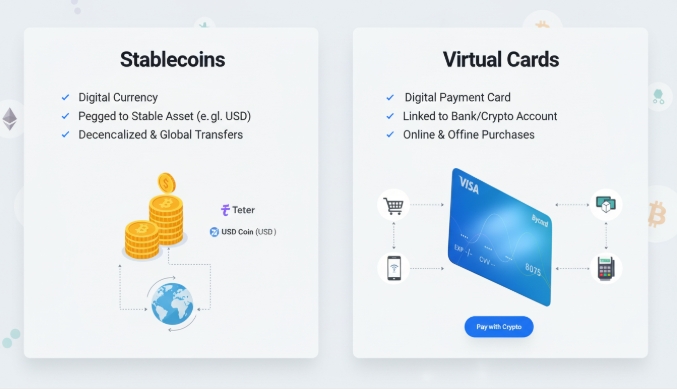
Both payment methods offer advantages, but they differ in several important ways.
Settlement Speed
Stablecoin transactions often settle within minutes depending on the blockchain network.
Card payments typically involve intermediaries and may take several days to fully settle.
Global Accessibility
Stablecoins can move value globally without relying on banking relationships.
Virtual cards depend on existing financial networks and issuing institutions.
However, platforms like Bycard increasingly bridge this gap by enabling multi-currency payments and global card acceptance, allowing businesses to pay international vendors and digital services without complicated cross-border transfers.
Regulatory Environment
Card networks operate within established regulatory frameworks worldwide.
Stablecoins are still navigating evolving regulations in many jurisdictions.
Where Stablecoins May Have an Advantage
Stablecoins may be particularly useful in environments where traditional banking access is limited.
Emerging Markets
In regions with limited financial infrastructure, stablecoins can act as digital cash.
Users can send and receive funds without opening a bank account.
Programmable Payments
Blockchain systems allow developers to automate payments using smart contracts.
This means an AI agent could trigger transactions based on predefined rules without human intervention.
Where Virtual Cards May Continue to Lead
Despite the innovation surrounding stablecoins, virtual cards still have several advantages.
Merchant Acceptance
Millions of merchants worldwide already accept card payments. Virtual cards can be used almost anywhere online.
Stablecoin acceptance, while growing, remains limited to specific platforms and services.
Compliance Infrastructure
Card networks include built-in compliance mechanisms such as identity verification, fraud monitoring, and dispute resolution.
These systems reduce risk for businesses deploying automated payments.
Virtual card platforms also provide expense tracking, budgeting tools, and real-time transaction monitoring, allowing finance teams to maintain visibility over automated spending. Tools offered by Bycard, for example, allow companies to track payments, generate expense reports, and manage budgets from a centralized dashboard.
AI Agents and the Next Phase of Digital Commerce
As AI agents become more capable, the number of automated transactions could increase significantly.
An AI-powered business assistant might:
- Pay SaaS subscriptions
- Purchase advertising inventory
- Handle vendor invoices
- Manage international payments
Each of these activities requires reliable payment rails.
Virtual cards already support many of these use cases. For instance, businesses using Bycard can create dedicated cards for AI tools, marketing campaigns, or vendor subscriptions, thereby reducing billing errors and preventing spending overlap across departments.
This type of structure allows companies to maintain control while still enabling automation.
Stablecoins offer speed and programmability, whereas virtual cards offer global acceptance and established infrastructure.

Perfect Card for running ads!
Conclusion
The growth of AI agents is likely to reshape how digital payments work.
Stablecoins are expanding rapidly in terms of market cap, transaction volume, and real-world use cases. At the same time, virtual cards continue to dominate online commerce thanks to their compatibility with existing financial systems.
Solutions like Bycard show how virtual card infrastructure is evolving alongside automation, offering instant card issuance, spending controls, multi-currency support, and real-time transaction visibility that make automated digital payments easier to manage.

CATEGORIES
Wise or Revolut? Comparing the Best Multi-Currency Card
Wise Alternatives That Make Payment Faster and Currency Conversion Simple

Wire Transfer vs Bank Transfer for Better & Swift Business Payments

Why Travel Rewards Credit Cards are Highly Important

Why the Ramp Card Might Be the Best Business Card

Why Sales and Discounts Make You Overspend
