
 Log in
An In-Depth Explanation of Stablecoins and Their Different Types
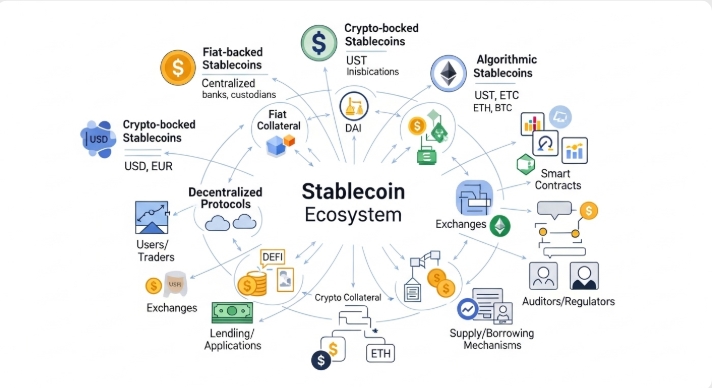
Cryptocurrency introduced a new way to move money across the internet. But one challenge quickly became clear: price volatility.
A cryptocurrency can rise or fall dramatically in a short period of time. That volatility makes it difficult to use many digital assets for everyday transactions, savings, or business payments.
Stablecoins were created to solve this problem.
Stablecoins are digital currencies designed to maintain a relatively stable value, usually by linking their price to an external asset like the US dollar. Instead of fluctuating constantly like many cryptocurrencies, they aim to hold a consistent price, making them easier to use for payments, transfers, and financial operations.
Over time, stablecoins have become one of the most widely used components of the crypto ecosystem, supporting trading markets, cross-border payments, and decentralized finance.
But stablecoins are not just theoretical financial tools anymore. Platforms like Bycard are helping connect stablecoins to everyday spending by allowing users to convert digital assets like USDT into virtual cards that can be used for global payments, subscriptions, and business expenses.
To understand why stablecoins have become so important, it helps to look closely at how they work and the different types that exist.
- An In-Depth Explanation of Stablecoins and Their Different Types
- Why Stablecoins Became Important in Crypto
- The Main Types of Stablecoins
- Fiat-Backed Stablecoins
- Crypto-Collateralized Stablecoins
- Algorithmic Stablecoins
- Commodity-Backed Stablecoins
- How Stablecoins Maintain Their Price Peg
- Real-World Uses of Stablecoins
- Risks and Considerations When Using Stablecoins
- The Role Stablecoins Play in the Digital Economy
Why Stablecoins Became Important in Crypto
Stablecoins solved a practical problem that early cryptocurrencies struggled with: usability.
If a digital asset’s price changes constantly, businesses cannot reliably price products, and users cannot confidently store value.
Stablecoins provide a predictable unit of value on blockchain networks, which allows them to function more like digital cash.
Today they are widely used for several practical purposes.
Payments and Global Transfers
Stablecoins allow people to send value globally without relying on slow banking systems.
Transactions settle directly on blockchain networks, often within minutes, making them useful for:
- international transfers
- freelancer payments
- vendor invoices
Businesses increasingly combine stablecoins with payment infrastructure platforms like Bycard, which convert crypto balances into virtual Visa or Mastercard cards for global payments.
This allows companies to fund payments with stablecoins while still using familiar payment networks for things like software subscriptions, advertising spend, or vendor payments.
Crypto Trading and Market Liquidity
Stablecoins act as a neutral base currency on many cryptocurrency exchanges.
Instead of converting to traditional money, traders can move between volatile assets and stablecoins quickly.
In fact, stablecoins support a large percentage of trading pairs across global crypto exchanges.
Decentralized Finance (DeFi)
Stablecoins are widely used in DeFi applications such as:
- Lending platforms
- Liquidity pools
- Decentralized exchanges
- Yield strategies
Their stable price makes them suitable as collateral and settlement assets in these systems.
Access to Digital Dollars
In many parts of the world, accessing stable and globally accepted currencies like the US dollar is not always easy. People in countries with high inflation, strict currency controls, or limited banking infrastructure often face challenges when trying to store value in stable foreign currencies.
Stablecoins offer a practical alternative.
Because they exist on blockchain networks, stablecoins allow anyone with an internet connection and a digital wallet to hold and transfer assets that closely track the value of the US dollar, without needing a foreign bank account.
This has made stablecoins particularly useful in emerging markets where:
- Local currencies experience rapid inflation
- Banking services are limited or expensive
- International transfers take several days to settle
In these situations, stablecoins can function as a form of digital dollar access. Users can receive payments, store value, and send funds internationally without interacting with traditional banking systems.
Adoption has grown quickly in regions across Africa, Latin America, and Southeast Asia, where freelancers, remote workers, and small businesses increasingly accept stablecoins as payment for cross-border work.
The Main Types of Stablecoins
Stablecoins can generally be divided into several categories depending on how they maintain their price stability.
The main types include:
- Fiat-backed stablecoins
- Crypto-collateralized stablecoins
- Algorithmic stablecoins
- Commodity-backed stablecoins
Each model relies on different mechanisms.
Fiat-Backed Stablecoins
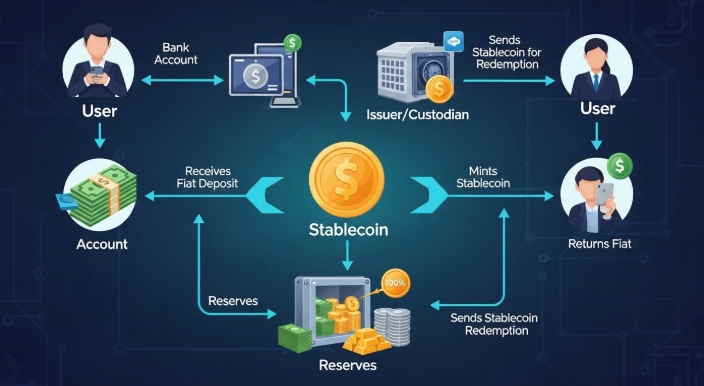
Fiat-backed stablecoins are currently the most widely used type of stablecoin in the market.
These stablecoins maintain their value by holding traditional financial assets as reserves. In most cases, the stablecoin is pegged to the US dollar, meaning each token aims to maintain a value of one dollar.
The reserves backing these tokens are typically stored by the issuing company and may include:
- Bank deposits
- Short-term government bonds
- Money market instruments
- Cash equivalents
Because the reserves exist outside the blockchain, users rely on the issuer to maintain sufficient backing.
Despite this centralized structure, fiat-backed stablecoins have become dominant because they are simple, widely trusted, and easy to use across trading platforms and payment systems.
They are often used as the primary settlement asset across cryptocurrency exchanges and are widely accepted across many financial applications in the crypto ecosystem.
How Fiat-Backed Stablecoins Work
The concept is relatively simple.
For every stablecoin issued, the issuer claims to hold an equivalent amount of fiat currency or short-term financial instruments.
Example structure:
- $1 deposited into reserves
- 1 stablecoin token issued
- Token redeemable for $1
These reserves may include:
- bank deposits
- treasury bills
- money market instruments
Transparency and regular audits are important because users rely on the issuer to maintain these reserves.
Advantages
Fiat-backed stablecoins have several characteristics that contribute to their widespread adoption.
Simple structure
The reserve model is easy to understand. Each token represents a claim on a corresponding amount of fiat currency held in reserve.
High liquidity
Fiat-backed stablecoins are widely traded across cryptocurrency exchanges and decentralized finance platforms, making them easy to buy, sell, or transfer.
Broad acceptance
Because they closely track the value of the US dollar, these stablecoins are widely accepted across trading platforms, payment systems, and digital financial services.
This combination of simplicity and liquidity has made fiat-backed stablecoins the dominant model in the stablecoin market today.
Potential Risks
- Dependence on centralized issuers
- Reserve transparency concerns
- Regulatory oversight
Despite these risks, fiat-backed models dominate stablecoin usage today.
Crypto-Collateralized Stablecoins
Crypto-collateralized stablecoins rely on a different mechanism to maintain stability.
Instead of holding traditional financial reserves, these systems require users to lock cryptocurrency as collateral within smart contracts.
The collateral remains on the blockchain and is visible publicly, which allows users to verify the system’s backing in real time.
These stablecoins are typically issued through decentralized protocols that automatically manage collateral and maintain price stability through programmed rules.
Overcollateralization
Because cryptocurrencies are volatile, crypto-backed stablecoins usually require more collateral than the value of the issued stablecoins.
Example:
- $150 of crypto deposited
- $100 of stablecoins issued
If the collateral value drops below a certain threshold, the system automatically liquidates the collateral.
Advantages
- More decentralized
- Transparent collateral stored on-chain
- No reliance on banks
Risks
- Exposure to crypto price volatility
- liquidation events during market crashes
- complex systems for new users
Algorithmic Stablecoins
Algorithmic stablecoins attempt to maintain their peg without relying on collateral reserves.
Instead of backing tokens with assets, they rely on automated monetary policies controlled by algorithms.
These systems attempt to balance supply and demand by adjusting the number of tokens in circulation.
How Algorithmic Systems Work
The basic idea behind algorithmic stablecoins is similar to how central banks manage currency supply.
When the price of the stablecoin rises above its target value:
- the protocol increases supply
- additional tokens are issued
When the price falls below the peg:
- supply is reduced
- tokens may be burned or removed from circulation
These adjustments are intended to push the market price back toward the target value.
Advantages
Algorithmic stablecoins offer several theoretical benefits.
Capital efficiency
Because they do not require large collateral reserves, they can operate with lower capital requirements.
Automated monetary policy
The system automatically adjusts supply based on market conditions.
These models attempt to replicate aspects of traditional monetary policy using programmable blockchain systems.
Risks
Algorithmic stablecoins have historically proven difficult to maintain during periods of market stress. Because they rely heavily on market confidence, a sudden loss of trust can cause the peg to break. Without strong collateral backing, these systems can enter downward spirals if users begin rapidly selling the token.
For this reason, many developers and investors now view collateralized stablecoin models as more resilient.
Commodity-Backed Stablecoins
Some stablecoins are backed by physical assets such as gold.
Each token represents a claim on a specific amount of a commodity stored in reserves.
Example:
- 1 token = 1 gram of gold
These tokens allow users to hold commodity exposure in a digital form.
Advantages
Commodity-backed stablecoins provide several unique benefits.
Tangible asset backing
Unlike algorithmic models, these tokens represent ownership of real physical assets.
Inflation hedge
Commodities like gold are often viewed as long-term stores of value during periods of inflation or currency instability.
Risks
- reliance on custodians storing the asset
- limited liquidity compared to dollar stablecoins

Perfect Card for running ads!

How Stablecoins Maintain Their Price Peg
Maintaining a stable price requires several mechanisms working together.
Different stablecoin models rely on different stabilization strategies.
Reserve Backing
Fiat-backed stablecoins rely on reserves that allow users to redeem tokens for traditional currency.
Collateral Ratios
Crypto-backed stablecoins require collateral exceeding the value of issued tokens.
Arbitrage Incentives
Traders often help stabilize stablecoins.
Example:
If a stablecoin drops to $0.98
Traders buy it and redeem it for $1.
This pushes the price back toward the peg.
Supply Adjustments
Algorithmic stablecoins attempt to stabilize price by increasing or decreasing supply depending on market demand.
These automated adjustments aim to push the price back toward the target value.
Real-World Uses of Stablecoins
Stablecoins have expanded far beyond trading. They are now used in a growing range of real-world financial activities.
Cross-Border Payments
Stablecoins allow users to transfer funds internationally without relying on traditional banking networks. Because transactions settle on blockchain networks, transfers can occur within minutes rather than several business days.
This makes them particularly useful for international payments and remittances.
Business Payments and Freelancer Payouts
Many startups and digital businesses now use stablecoins to pay:
- freelancers
- remote teams
- international vendors
Tools like Bycard allow businesses to fund virtual payment cards using stablecoins, making it easier to pay vendors, run advertising campaigns, or manage software subscriptions without relying on traditional banking systems.
Companies can also set spending limits, issue multiple cards for teams, and track expenses in real time, which helps manage operational budgets more efficiently.
E-commerce and Online Services
Stablecoins are increasingly used to fund online services such as:
- advertising platforms
- SaaS subscriptions
- cloud infrastructure
- digital marketing tools
Payment platforms that connect stablecoins with card networks allow businesses to spend digital assets directly within existing payment ecosystems, making them easier to use for everyday online transactions.
Risks and Considerations When Using Stablecoins
Despite their stability, stablecoins still carry risks.
Reserve Transparency
Some stablecoin issuers provide detailed reserve disclosures, while others offer limited reporting.
Users should review reserve attestations and financial disclosures to better understand how a stablecoin is backed.
Regulatory Uncertainty
Governments around the world are still developing regulatory frameworks for stablecoins.
Future regulations may affect how stablecoins are issued, stored, or used in financial systems.
Platform Risk
The platforms used to store, convert, or spend stablecoins also matter.
Payment infrastructure providers such as Bycard reduce some operational risks by offering features like spending limits, transaction monitoring, and secure virtual cards, which can improve oversight for businesses using digital assets.
The Role Stablecoins Play in the Digital Economy
Stablecoins are sometimes described as the financial plumbing of the crypto market.
They allow value to move across exchanges, blockchains, and financial applications without relying on traditional banking rails for every transaction.
This has enabled:
- Faster settlement between platforms
- Liquidity for trading markets
- New forms of decentralized financial services
As blockchain technology continues to develop, stablecoins may remain one of the most practical and widely used digital assets.
Payment tools like Bycard illustrate this hybrid approach by connecting stablecoins to familiar tools like Visa and Mastercard payment networks, allowing digital assets to function more like everyday money.
Conclusion
Stablecoins were introduced to address one of cryptocurrency’s biggest limitations: price volatility. By linking digital tokens to external assets or stabilization mechanisms, they provide a way to move value across blockchain networks while maintaining a relatively stable price.
Different types of stablecoins achieve this stability in different ways, some rely on fiat reserves, others depend on crypto collateral, and some attempt to stabilize price through algorithmic supply adjustments.
As the ecosystem grows, stablecoins are increasingly being used for payments, business operations, and global transfers, not just trading.
Infrastructure platforms like Bycard are helping make this possible by allowing users to convert stablecoins into spendable virtual cards for global payments, vendor invoices, advertising spend, and everyday online purchases.
This kind of bridge between blockchain assets and traditional payment networks is one reason stablecoins are becoming a practical financial tool rather than just a trading instrument.

CATEGORIES

Wise or Revolut? Comparing the Best Multi-Currency Card

Wise Alternatives That Make Payment Faster and Currency Conversion Simple

Wire Transfer vs Bank Transfer for Better & Swift Business Payments

Why Travel Rewards Credit Cards are Highly Important

Why the Ramp Card Might Be the Best Business Card

Why Sales and Discounts Make You Overspend
