
 Log in
Bitcoin’s 4-Year Cycle Is Dead: Stablecoins Changed It
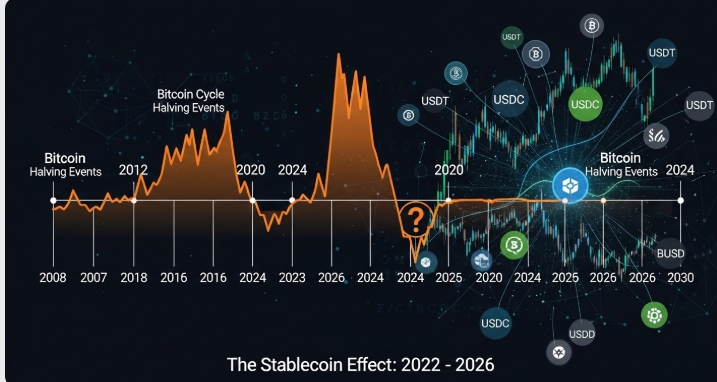
The Bitcoin halving cycle everyone relies on just got disrupted by stablecoins.
For over a decade, Bitcoin traders have treated the 4-year halving cycle as gospel. Buy during the bear market following a halving, hold through the supply shock, and sell 12-18 months after the next halving when retail FOMO peaks. This pattern played out in 2013, 2017, and 2021 with remarkable consistency. But the market structure that made those cycles predictable no longer exists.
The reason? A fundamental shift in how liquidity flows into Bitcoin markets. The traditional cycle depended on waves of capital that entered and exited the market in predictable patterns, retail investors chasing price momentum, followed by institutional players during bull runs, then a mass exodus during bear markets. Today, over $200 billion in stablecoins sits permanently on-chain, providing constant liquidity that smooths these violent swings. Platforms like Bycard play a growing role in this system by enabling users to move between crypto assets and real-world payments without needing to fully exit the ecosystem.
This isn’t a temporary anomaly; it’s a structural change that renders cycle-based investment strategies increasingly obsolete.
- Bitcoin's 4-Year Cycle Is Dead: Stablecoins Changed It
How Continuous Stablecoin Liquidity Differs from Previous Cycle Funding Sources
To understand why stablecoins break the cycle, we need to examine how Bitcoin markets were funded in previous eras.
The Old Paradigm: Episodic Capital Flows
During the 2017 bull run, buying Bitcoin required a multi-day process. Retail investors wired fiat to exchanges, waited 3-5 business days for settlement, then purchased BTC. When prices crashed 85% in 2018, that capital disappeared. Investors withdrew to bank accounts, and liquidity evaporated. This created the characteristic boom-bust pattern: explosive rallies fueled by incoming wire transfers, followed by capitulation as that same money fled back to traditional finance.
Institutional involvement in 2020-2021 followed a similar pattern. Firms like MicroStrategy and Tesla made large, publicized Bitcoin purchases that drove FOMO rallies. But these were discrete events, one-time capital allocations that created temporary demand spikes. When macro conditions shifted in 2022, institutional buyers stepped back, and once again, the market bled liquidity for over a year.
Both cycles exhibited the same characteristic: capital entered and exited completely, creating the pronounced 4-year rhythm of accumulation, explosion, distribution, and depression.
The New Reality: Persistent On-Chain Liquidity
Stablecoins have fundamentally altered this dynamic. USDT, USDC, and other dollar-pegged tokens now represent over $200 billion in capital that lives permanently on-chain. This isn’t money waiting in bank accounts to be wired, it’s already in the crypto ecosystem, available for deployment in seconds.
Consider the structural difference:
- 2017: Retail investor sees Bitcoin rally → Initiates wire transfer → Waits 3-5 days → Buys BTC (if still interested)
- 2024: Trader holds $100K in USDT → Sees opportunity → Swaps to BTC in 12 seconds → Exits to stablecoin in 12 seconds
This creates what market analysts call “reflexive liquidity.” Unlike previous cycles where money left the ecosystem entirely during downturns, stablecoin holders simply rotate between assets. A trader might exit Bitcoin at $95K, but that capital doesn’t disappear, it sits in USDT, waiting for the next entry point at $88K. Services like Bycard allow users to spend or convert their crypto directly for everyday transactions, meaning capital can remain within the broader crypto economy rather than exiting it entirely.
The numbers tell the story. Stablecoin market capitalization has grown from under $10 billion in early 2020 to over $200 billion today. Even during the brutal 2022 bear market, stablecoin supply only decreased 15%, a fraction of the 85%+ Bitcoin drawdown. Most critically, stablecoin on-chain transaction volume now exceeds $15 trillion annually, providing constant liquidity that prevents the total capital flight that defined previous cycle bottoms.
This persistent liquidity pool acts as a shock absorber. When Bitcoin drops 20%, traders rotate to stablecoins rather than cashing out completely. When opportunities emerge, capital flows back in hours, not months. The result? Shallower drawdowns, less pronounced tops, and a gradual erosion of the clean 4-year pattern.
Why Asset Tokenization in 2026 Accelerates the Breakdown of 4-Year Patterns

If stablecoins disrupted the Bitcoin cycle, asset tokenization is about to bury it completely.
The next phase of market evolution involves bringing traditional financial assets on-chain through tokenization. BlackRock’s tokenized treasury fund (BUIDL) and similar products already represent billions in traditional finance capital that can be deployed into crypto markets 24/7/365. By 2026, analysts project over $1 trillion in tokenized real-world assets (RWAs) will exist on blockchain networks.
Here’s why this matters for Bitcoin cycles:
24/7 Global Liquidity Replaces Market-Hours Capital
Traditional Bitcoin cycle funding depended on business hours and banking schedules. Wire transfers processed Monday-Friday. Institutional allocations required committee approvals and multi-day settlement. This created natural rhythms in capital flow, weekly patterns, monthly patterns, and ultimately the 4-year macro pattern tied to halving dates.
Tokenized assets eliminate these friction points. A Hong Kong hedge fund can sell tokenized US treasuries at 3 AM on Sunday and deploy proceeds into Bitcoin within minutes. A European pension fund can rotate from tokenized bonds to BTC during New York’s sleep hours. The concept of “market hours” becomes meaningless when trillions in tokenized traditional finance assets can flow into crypto markets continuously.
This constant liquidity access means Bitcoin can no longer build the supply-demand imbalances that created previous cycle peaks. When price rises too quickly, tokenized asset holders can instantly take profits. When opportunities emerge, traditional finance capital can deploy immediately without waiting for wire transfers or exchange on-boarding. Payment and spending platforms like Bycard help bridge this gap, allowing users to access or deploy their crypto capital without waiting for traditional banking hours.
Regulatory Clarity Drives Institutional Stablecoin Adoption
The 2024-2025 period has seen unprecedented regulatory development around stablecoins. The European Union’s MiCA framework, US stablecoin legislation, and institutional-grade custody solutions have created the compliance infrastructure that major financial players demanded.
By 2026, expect major banks and asset managers to hold substantial stablecoin reserves as part of normal treasury operations. When Goldman Sachs or JP Morgan can move $500 million into Bitcoin via institutional stablecoins in minutes, rather than weeks of paperwork and settlement, the episodic “institutional waves” that marked 2020-2021 get replaced by continuous institutional participation.
This doesn’t mean institutions will constantly buy Bitcoin. It means they’ll be able to buy or sell instantly based on real-time analysis rather than multi-week allocation processes. The result is more efficient price discovery and elimination of the lag-driven momentum that created past cycle peaks.
Why the 4-Year Cycle Mechanics Are Now Obsolete
The Bitcoin halving itself hasn’t changed, supply issuance still cuts in half every four years. But the market’s ability to price this in has fundamentally evolved.
Previous cycles saw delayed price responses to supply shocks because capital couldn’t flow efficiently. The 2016 halving took 18 months to fully impact price because it took that long for retail and institutional awareness to build, capital to flow in through slow banking channels, and momentum to reach critical mass.
With $200+ billion in stablecoins and growing tokenized asset markets, the halving gets priced in real-time. Sophisticated market participants can instantly deploy capital when they perceive supply-demand imbalances. This creates a more efficient, but less predictable, market that doesn’t follow neat 4-year patterns.
What This Means for Timing Bitcoin Investments Going Forward
If the 4-year cycle is dead, what replaces it?
The Death of Simple Timing Strategies
The classic “buy the halving year, sell 18 months later” approach worked because market inefficiency created predictable lag. That inefficiency no longer exists at scale. Traders armed with stablecoins and real-time data can’t be systematically front-run by halving dates anymore.
This doesn’t mean Bitcoin won’t appreciate long-term. It means the path will be less predictable. Instead of one massive parabolic blow-off top 18 months after each halving, expect multiple smaller rallies and corrections as efficient markets constantly adjust to new information.
New Metrics to Replace Cycle Analysis
Smart traders are already shifting focus from halving countdowns to more relevant indicators:
1. Stablecoin Supply Growth: Rising stablecoin market cap indicates growing dry powder for Bitcoin purchases
2. On-Chain Stablecoin Balances: High exchange stablecoin reserves suggest capital waiting to deploy
3. Tokenized Asset Growth: Expansion of on-chain RWAs increases potential liquidity sources
4. Exchange Netflows: Real-time data on Bitcoin moving to/from exchanges provides immediate sentiment signals
5. Funding Rates: Perpetual futures funding shows whether leverage is building (potential correction) or resetting (opportunity)
These metrics update continuously rather than following 4-year schedules, reflecting the new market reality.
The Importance of Staying Nimble and Liquid
In a cycle-driven market, you could afford to be patient. Buy during the bear, hold for 2-3 years, sell near the halving anniversary. In the new environment, opportunities and risks emerge faster.
This requires maintaining liquidity and the ability to act quickly. Traders who can efficiently move between Bitcoin, stablecoins, and fiat have enormous advantages over those locked into long-term positions based on outdated cycle expectations.
Risk Management in a Cycle-Less Environment
Without clear 4-year cycle tops and bottoms, traditional risk management evolves:
- Take profits incrementally rather than waiting for a predicted cycle peak
- Average into positions instead of trying to time a perfect cycle bottom
- Use shorter timeframes for technical analysis since macro patterns are less reliable
- Diversify entry and exit points across multiple price levels
- Maintain stablecoin reserves to capitalize on sudden opportunities
The goal shifts from timing one perfect cycle trade to consistently capturing shorter-term inefficiencies.
Adapting to the New Bitcoin Market Structure

The disruption of Bitcoin’s 4-year cycle isn’t a temporary anomaly, it’s the natural evolution of a maturing market gaining institutional infrastructure.
Stablecoins provided the first shock absorber, creating permanent on-chain liquidity that prevents total capital flight during downturns. Asset tokenization will complete the transformation, bringing trillions in traditional finance capital into 24/7 crypto markets. The result is a more efficient, more liquid, but fundamentally less predictable market that doesn’t follow neat halving-based patterns.
For traders, this new reality demands different strategies. The “buy and hold through the cycle” approach worked when markets were inefficient and capital flows were episodic. Today’s environment rewards nimbleness, real-time analysis, and the ability to rapidly adjust positions as conditions change.
This is where having reliable infrastructure becomes critical. When opportunities emerge at 2 AM on a Sunday, because tokenized markets never sleep, you need platforms that provide instant execution at competitive rates. Whether you’re rotating from Bitcoin to stablecoins to preserve profits, or deploying reserves when you spot an entry point, speed and reliability matter more than ever.
Platforms like Xbankang are built for this new reality, offering instant crypto-to-fiat conversions, competitive rates on Bitcoin and stablecoin trades, and 24/7 support for traders who can’t afford to wait for business hours. In a market that no longer sleeps or follows predictable 4-year patterns, your trading infrastructure needs to keep pace.
The Bitcoin 4-year cycle served traders well for over a decade. But market structures evolve, and successful investors evolve with them. The stablecoin revolution has rewritten the rules, those who adapt will thrive in this new, cycle-less era of Bitcoin markets.

Perfect Card for Crypto!
Conclusion
Bitcoin’s four-year cycle wasn’t a permanent rule, it was the result of how money moved through early crypto markets.
Stablecoins have changed that by keeping liquidity permanently on-chain, while tokenized assets are bringing even more capital into always-open markets.
In this environment, success depends less on predicting cycles and more on staying flexible. Investors who can move capital quickly, respond to real-time signals, and access infrastructure that connects crypto with everyday financial use, through services like Bycard, will be better positioned in the next phase of Bitcoin’s evolution.

CATEGORIES
Wise or Revolut? Comparing the Best Multi-Currency Card

Wise Alternatives That Make Payment Faster and Currency Conversion Simple

Wire Transfer vs Bank Transfer for Better & Swift Business Payments

Why Travel Rewards Credit Cards are Highly Important

Why the Ramp Card Might Be the Best Business Card

Why Sales and Discounts Make You Overspend
