
 Log in
Consumer Psychology: Why We Overspend at Sales

Your brain on discounts: the neuroscience of overspending. That red “50% OFF” sticker isn’t just ink on paper, it’s a precisely engineered psychological weapon designed to bypass your rational decision-making and trigger a cascade of neural responses that make you reach for your wallet. Every year, consumers spend billions on items they never intended to purchase, convinced they’re saving money when they’re actually doing the opposite. This paradox sits at the heart of behavioral economics: the systematic ways our minds betray our best financial interests when confronted with the illusion of a deal.
Retailers don’t just sell products, they architect experiences that exploit predictable irrationalities in human cognition. Understanding these mechanisms isn’t about feeling guilty for past purchases; it’s about recognizing the invisible forces shaping your decisions and reclaiming agency over your spending. Let’s dissect exactly how discount psychology works, why your brain falls for it every time, and what concrete strategies can protect you from your own neural programming.
- Consumer Psychology: Why We Overspend at Sales
The Anchoring Illusion—How Fake Comparison Pricing Manipulates Value
The foundation of discount psychology rests on a cognitive bias called anchoring: our tendency to rely heavily on the first piece of information we encounter when making decisions. Retailers weaponize this by presenting inflated “original prices” that serve no purpose except creating a psychological reference point.
Consider the ubiquitous strikethrough price: ~~$199~~ $99. Your brain doesn’t evaluate whether $99 represents the product’s fair value. Instead, it automatically calculates the $100 difference and floods your system with the sensation of “winning.” Research from the Journal of Consumer Research demonstrates that consumers exposed to higher anchor prices perceive identical products as higher quality and are willing to pay more, even when they know the original price is arbitrary.
This manifests in several retail tactics:
Manufacturer’s Suggested Retail Price (MSRP) manipulation: Many products are designed with inflated MSRPs that retailers never charge. A “$500 MSRP” blender permanently sold for $149 creates perpetual “savings” that exist only on paper. The Federal Trade Commission has cracked down on some egregious cases, but the practice remains widespread because it works.
Phantom reference pricing: Department stores frequently mark up items specifically to mark them down. That “original price” may have existed for exactly one week before the item went “on sale” for its intended selling price. Studies of retail pricing patterns reveal that some items spend 90% of their shelf life “discounted” from fictional highs.
The comparison blindness effect: When presented with a discount, consumers stop comparing across retailers or evaluating their actual needs. A 2019 study found that shoppers shown “40% off” labels were 60% less likely to price-check competitors than those shown absolute prices. The discount itself becomes the value proposition, regardless of whether better deals exist elsewhere.
The neuroscience here is fascinating: fMRI studies show that seeing discounted prices activates the brain’s reward centers, the same regions that light up with food, sex, and addictive substances. The strikethrough price activates the prefrontal cortex (associated with loss aversion, you might “miss out” on savings), while the discounted price triggers the nucleus accumbens (anticipation of reward). This one-two neurological punch overwhelms rational evaluation.
What makes anchoring particularly insidious is its persistence even among informed consumers. Knowing about the bias doesn’t neutralize it. Behavioral economists who study these effects professionally still report falling victim to anchoring in their own purchasing. It’s not a knowledge problem, it’s a fundamental feature of how human cognition processes numerical information.
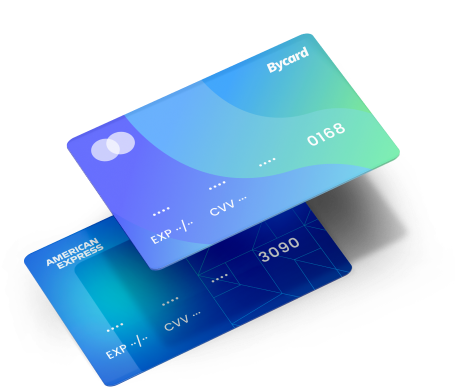
One way to counter anchoring bias is to separate your spending tools by intent. Using a dedicated virtual card like Bycard for planned purchases only creates a structural barrier between impulse-driven browsing and intentional buying. When discounts appear, you’re forced to decide whether the item truly fits within your pre-approved spending category rather than reacting emotionally to a slashed price.
The Impulse Engine—Trigger Mechanisms in Discount Retail Environments
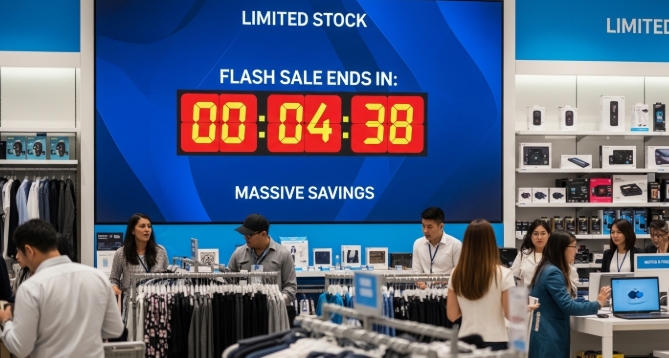
While anchoring sets the stage, retailers deploy an arsenal of additional psychological triggers to convert browsing into buying. These mechanisms exploit our evolutionary wiring, cognitive shortcuts that helped our ancestors survive but make us vulnerable to modern commercial manipulation.
Scarcity and urgency architecture: “Only 3 left in stock!” “Sale ends in 4 hours!” These aren’t informational messages; they’re psychological accelerants. The principle of scarcity, documented extensively by Robert Cialdini in Influence, shows that humans assign greater value to things that appear rare or time-limited. Your brain’s amygdala interprets potential loss of opportunity as a threat, triggering cortisol release and anxiety that can only be resolved by purchasing.
Retailers have refined this into a science. Online platforms use dynamic inventory displays (sometimes artificially constrained), countdown timers, and “other people are viewing this item” notifications to manufacture urgency. The psychology is brutally effective: studies show conversion rates increase by 200-400% when scarcity cues are present, regardless of whether consumers actually need the product.
The dopamine economy: Getting a “deal” produces measurable dopamine release, the neurotransmitter associated with pleasure and motivation. This isn’t metaphorical; it’s biochemical. The anticipation of saving money activates reward pathways similar to gambling, creating a mild euphoric state that clouds judgment.
This explains why people often report a “high” from shopping, followed by regret once the neurochemical cascade subsides. You’re not weak-willed; you’re experiencing a drug-like response to perceived savings. Retailers engineer “treasure hunt” environments (constantly rotating deals, limited quantities, surprise discounts) specifically to trigger repeated dopamine hits that keep shoppers engaged and impulsive.
Impulse spending thrives on frictionless payments. One-click checkouts and saved debit cards remove the pause your rational brain needs. Using a controlled spending method like Bycard, where you preload or allocate a fixed amount specifically for discretionary purchases, reintroduces healthy friction. Once that allocation is exhausted, the impulse cycle stops automatically, no emotional negotiation required.
Loss aversion asymmetry: Pioneered by Daniel Kahneman and Amos Tversky, loss aversion describes our tendency to feel losses more intensely than equivalent gains. Psychologically, losing $50 hurts roughly twice as much as gaining $50 feels good.
Sales exploit this by framing purchases as avoiding loss rather than acquiring goods. “Save $100!” feels like preventing a $100 loss, even though you’re actually spending money. The “missing out” fear, exacerbated by social media showing others’ purchases, transforms not buying into a perceived loss of both product and savings.
Environmental manipulation: Physical and digital store design incorporates findings from environmental psychology to lower purchase resistance. Slow-tempo music increases browsing time and spending. Checkout-aisle impulse items catch you in a depleted will power state after making multiple decisions. Cart minimums for free shipping push order values above the intended spending.
Creating separate virtual cards for categories, travel, subscriptions, online shopping, through tools like Bycard can prevent environmental triggers from spilling into your entire budget. If a retailer pushes you to hit a free-shipping threshold, your category balance becomes a visible boundary, making it easier to walk away instead of upsizing your order.
Online, the “shopping cart” itself is a psychological device, adding items creates a sense of ownership (the endowment effect) that makes abandoning the cart feel like losing possessions you already have. Amazon’s one-click purchasing removes friction deliberately, preventing the pause that might trigger reconsideration.
Social proof cascades: “Bestseller!” “10,000+ reviews!” “Trending now!” These signals hijack our evolved tendency to learn from others’ behavior. If thousands of people bought something, our instinctive reasoning goes, it must be valuable, a shortcut that worked well in ancestral environments but leads us astray when ratings are manipulated, and popularity is engineered.
Building Immunity—Personal Rules to Counteract Psychological Spending Traps

Understanding these mechanisms is necessary but insufficient. Awareness alone rarely overcomes deeply embedded cognitive biases. The solution lies in implementing external systems and rules that compensate for our neurological vulnerabilities.
- The 48-hour quarantine rule: For any non-essential purchase over a threshold you set, enforce a mandatory waiting period. Studies show that 60-70% of impulse purchases aren’t completed when a waiting period is imposed..
Pair the 48-hour rule with a locked discretionary card. Instead of keeping your primary debit card active for online purchases, use a virtual card like Bycard that you only fund after the waiting period passes. If the urge disappears within two days, the card never gets funded, and the purchase never happens.
- The need-versus-want interrogation: Ask yourself: Did I need this before I saw it on sale? Would I buy it at full price? What problem does this solve?
- Cost-per-use calculation: Shift evaluation from sticker price to utility value.
- Price tracking and historical data: Use tools to view price history and eliminate artificial urgency.
- Budget boundaries with zero exceptions: Allocate a specific discretionary spending amount monthly.
Budget boundaries work best when automated. Allocating your monthly discretionary allowance directly into a separate Bycard creates a hard cap. Unlike mental budgeting, which your brain can rationalize away, a capped card enforces discipline in real time.
- Unsubscribe and unfollow: Reduce exposure to psychological triggers.
- The replacement rule: Implement one-in-one-out policies.
- Mindful consumption audits: Monthly, review purchases and categorize them.
Transaction visibility also matters. Using a dedicated spending card allows you to clearly review discretionary purchases in isolation, making monthly audits more transparent and harder to ignore.
How Bycard Helps Streamline and Control Overspending
Bycard helps reduce and streamline overspending by introducing structure, visibility, and control into your discretionary spending:
- Separates essential and discretionary spending: You can create dedicated virtual cards for optional purchases like shopping, subscriptions, or entertainment, preventing impulse spending from affecting your main budget.
- Creates clear spending boundaries: Allocating a specific amount to a virtual card ensures your discretionary spending stays within predefined limits.
- Improves spending visibility: Bycard allows you to track transactions in real time, making it easier to identify patterns driven by impulse, flash sales, or psychological triggers.
- Reduces impulse-driven decisions: Using a separate virtual card adds a layer of intentionality, helping you pause and evaluate whether a purchase aligns with your priorities.
- Allows better budget management: Managing spending at the card level helps you maintain control over how much is allocated and spent in each category.
- Supports intentional financial behavior: Instead of relying only on willpower, Bycard provides a structured system that helps reinforce planned spending and prevent reactive purchases.

Perfect Card for running ads!
Conclusion
The discount industrial complex isn’t going anywhere. Anchoring, scarcity, dopamine manipulation, and loss aversion aren’t personal failings; they’re universal features of human cognition that retailers exploit systematically.
The goal isn’t to never enjoy a legitimate sale. It’s to ensure your purchases serve your authentic needs and values rather than retailers’ revenue targets. By implementing external systems, waiting periods, cost-per-use calculations, budget constraints, and using structured spending tools like Bycard to enforce those boundaries, you compensate for cognitive biases that awareness alone can’t overcome.
Every time you walk away from a “limited time offer” that doesn’t serve you, you’re not missing out. You’re exercising the most valuable form of consumer power: the ability to say no to manipulation and yes to intentionality. Your brain on discounts may be wired for overspending, but your systems can be wired for control.

CATEGORIES
Wise or Revolut? Comparing the Best Multi-Currency Card
Wise Alternatives That Make Payment Faster and Currency Conversion Simple
Wire Transfer vs Bank Transfer for Better & Swift Business Payments

Why Travel Rewards Credit Cards are Highly Important
Why the Ramp Card Might Be the Best Business Card
Why Privacy Card Is Changing Online Payment and Security
