
 Log in
5-Year Wealth Building Through Smart Spending Cuts

Cut these expenses now or miss your 5-year wealth window, because spending cuts are the fastest way to unlock investable capital.
The gap between those who build meaningful wealth and those who perpetually live paycheck to paycheck isn’t usually income; it’s the strategic reallocation of existing cash flow. You’ve heard the advice a thousand times: “Spend less, invest more.” But that platitude ignores the central challenge facing aspiring investors: which expenses should you cut, and where exactly should that freed capital go?
This is where tools like Bycard change the equation. Instead of manually tracking every transaction and hoping willpower wins, you can use smart card controls, categorized spending insights, and automated allocations to redirect freed cash into wealth-building channels immediately.
This isn’t about deprivation or living on ramen noodles. It’s about spending arbitrage, identifying low-value expenses that drain your accounts, and redirecting that same money into high-value investments that compound over time. The five-year window isn’t arbitrary. With compound growth at average market returns (7-10% annually), the money you invest today could nearly double by year five. Every month you delay is a month of potential growth you’ll never recover.
Identifying High-Impact Spending Cuts That Free Investment Capital
Not all spending cuts are created equal. Skipping your morning coffee might save ₦1,000, but canceling redundant subscriptions could free up ₦50,000 monthly. The 80/20 principle applies here: roughly 80% of your potential savings will come from 20% of your expense categories.
Category 1: Subscription Stacking
The average person now maintains 4-6 active subscriptions (streaming services, gym memberships, software licenses, premium apps) while actively using only 2-3. Audit every recurring charge hitting your account:
- Streaming services: Do you need Netflix, Prime Video, Disney+, and Showmax simultaneously? Rotate services every 2-3 months instead.
- Gym memberships: If you’ve visited less than 8 times in the past month, you’re paying approximately $5-$10 per actual workout. Switch to home workouts or pay-per-visit facilities.
- Software subscriptions: How many productivity apps overlap in functionality? Notion, Evernote, Microsoft 365, and Google Workspace often duplicate features.
Using Bycard’s recurring charge tracking, you can identify and freeze underused subscriptions in minutes instead of manually scanning statements.
Potential monthly savings: $75-$200
Category 2: Convenience Spending
Convenience is expensive. Food delivery apps, ride-hailing for short distances, same-day shipping, these micro-conveniences accumulate into macro-drains:
- Delivery fees and tips: Ordering food 3-4 times weekly at $8-$120 per delivery = $100-$180 monthly just in fees, before the marked-up food prices.
- Coffee and beverages: A$5 coffee daily is $150 monthly. Even cutting this in half frees $75.
- Impulse purchases: Those “small” online purchases ($15-$30 items that seem insignificant) add up to $200-$400 monthly.
A practical strategy is to set spending limits on categories prone to impulse behavior. Bycard allows you to set digital card restrictions or caps, reducing emotional purchases before they happen.
Potential monthly savings: ₦50,000-₦100,000
Category 3: Social Pressure Spending
This is the most psychologically difficult category to address. Status-signaling expenses often feel essential because they’re tied to identity and social belonging:
- Fashion and accessories: Fast fashion purchases to “keep up” with trends
- Dining out: Expensive restaurants to maintain social appearances
- Latest tech: Upgrading phones annually when your current device functions perfectly
Ask: “Does this genuinely improve my life, or am I signaling?”
Upgrading an $1,000 phone every year instead of every three years costs roughly $670 more per year, money that could be invested instead.
Potential monthly savings: $200–$600
Category 4: High-Interest Debt Payments
Debt with interest rates above 15–20% is a wealth destroyer. Every dollar spent on high-interest credit cards or loans is a dollar that could be compounding in investments. Aggressive debt payoff isn’t just about eliminating payments, it’s about freeing cash flow for wealth building.
If you’re paying $100 monthly in minimum payments on high-interest debt, eliminating that obligation through accelerated payoff creates $100 in monthly investment capacity.
Potential monthly savings after payoff: $75–$250
Combined potential from all strategic spending cuts: $300–$800 per month. Over five years at 8% annual returns, even the conservative $300 monthly grows to roughly $22,000.
Analyzing Discretionary vs Essential Spending Categories
Identifying what to cut requires a clear framework for categorizing expenses. Most budgeting advice uses the traditional needs vs. wants dichotomy, but that’s too simplistic. A more useful approach is the Joy vs. Cost Matrix.
The Joy vs. Cost Matrix
Plot each expense on two axes:
- Joy/Value Axis: How much genuine happiness or utility does this provide? (1-10)
- Cost Axis: What’s the monthly/annual expense?
This creates four quadrants:
- High Joy, High Cost: Optimize these (e.g., family vacations, look for deals instead of eliminating)
- Low Joy, Low Cost: Insidious, $5 here and there adds up
- Low Joy, High Cost: Cut immediately (e.g., $60 monthly gym membership you rarely use)
Run every expense through this filter. That premium cable package might seem essential, but if you score it honestly, you could be paying $35 for maybe 3 hours of weekly viewing (~$12/hour of entertainment).
Essential Spending Optimization
Even true essentials, housing, utilities, transportation, food, contain optimization opportunities:
- Housing: Can you negotiate rent? Refinance a mortgage? Take a roommate?
- Utilities: Energy-efficient bulbs, fixing leaks, and optimizing AC usage can cut electricity 20-30%
- Transportation: Carpooling, strategic fuel purchasing, or switching to public transit 3 days weekly
- Food: Meal planning eliminates waste and reduces grocery costs 25-35%
These aren’t sacrifices, they’re efficiency gains.
The 30-Day Audit Process
Here’s a practical approach:
1. Week 1: Export 3 months of bank/credit card statements
2. Week 2: Categorize every single transaction using the Joy vs. Cost Matrix
3. Week 3: Identify the bottom 20% (lowest joy, highest or moderate cost)
4. Week 4: Cancel, downgrade, or create elimination plans
Case Study: Sandra, a 29-year-old New York marketing professional earning $5,200 monthly after taxes, completed this audit and discovered:
- $180/month in stacked subscriptions (using only about $50 worth)
- $420/month in food delivery fees and convenience spending
- $260/month in impulse clothing purchases
By eliminating unnecessary subscriptions, cutting convenience spending in half, and applying a 48-hour rule for clothing, she freed $520 per month, a 24% reduction in discretionary spending.
Investing that $520 monthly for five years at 8% returns would grow to about $38,000.
The audit revealed that her happiness didn’t decrease; it increased because she eliminated low-joy expenses that were creating financial stress.
Automating Savings From Reduced Spending Into

Wealth-Building Accounts
Knowledge without execution is worthless. You can identify perfect spending cuts, but without a systematic process to redirect that freed capital, it simply inflates lifestyle spending elsewhere. This is where automation becomes non-negotiable.
The Psychology of Paying Yourself First
Traditional budgeting says: Income – Expenses = Savings. This fails because “savings” is the remainder, the afterthought. Reverse the equation:
Income – Savings/Investments = Expenses
When you automate transfers to investment accounts the day you receive income, you force your lifestyle to adapt to what remains. Your brain doesn’t miss money it never sees in checking.
Automation Strategies
Level 1: Basic Automation
- Set up automatic transfers from checking to a separate savings account the day after payday
- Start with 10-15% of income, then increase 1% every quarter
Level 2: Investment Automation
- Schedule automatic investments into index funds, ETFs, or robo-advisors
- Many American platforms now support recurring investment schedules
- Consider dollar-cost averaging into crypto or stocks through scheduled purchases
Level 3: Diversified Automation
- Multiple automatic allocations: 60% to stocks/index funds, 30% to savings, 10% to alternative investments
- Automatically funnel windfalls (bonuses, freelance income, tax refunds) at 50-80% investment rate

Perfect Card for running ads!
Where to Redirect Freed Capital
The investment ladder follows this sequence:
1. Foundation (Months 1-3): Build a $1,000-$2,000 emergency fund in high-yield savings
2. Growth Phase (Months 4-60): Index funds, ETFs, dividend stocks, broad market exposure
3. Acceleration Phase: Alternative investments (real estate crowdfunding, peer-to-peer lending)
4. Liquidity Optimization: For assets like unused gift cards or crypto holdings, platforms like *Xbankang offer competitive rates to convert these to naira quickly, ensuring you can redirect that capital into investments without delay
The key is liquidity meets opportunity. If you receive bonuses in gift cards or hold crypto that’s not actively growing, converting to cash at optimal rates means you can immediately deploy that capital into your investment strategy rather than letting it sit idle.
Tracking and Adjusting
Automation doesn’t mean “set and forget.” Quarterly reviews ensure:
- Your spending cuts remain in place (subscriptions have a way of creeping back)
- Investment allocations align with goals
- You’re increasing investment percentages as income grows
Use the same 30-day audit quarterly, but condense it to a weekend review.
The 5-Year Wealth Window: Why Timing Matters
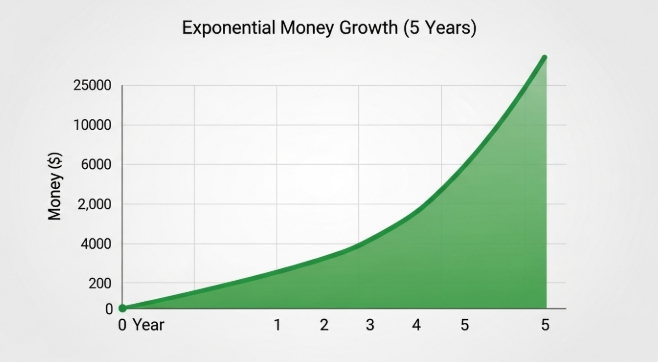
Compound growth is exponential, not linear. Money invested in year one has five full years to grow; money invested in year three only has three. The difference is significant:
- $250 invested monthly for 5 years at 8% = ~$18,400
- $250 invested monthly for 3 years at 8% = ~$10,200
That two-year delay costs ~$8,200 in potential wealth. This is your window.
The expenses you cut this week compound over 60 months. Expenses cut next year only have 48 months. Every month counts.
Your Next Step:
- Block two hours this weekend and export your bank statements.
- Run the audit and identify three expenses in the “Low Joy, High Cost” quadrant.
- Cancel them Monday.
- Set up automatic transfers for 50% of the freed amount by Wednesday.
The gap between wanting wealth and building wealth is execution. The five-year window is open, but it won’t stay open forever.
Wealth isn’t built through income alone. It’s built by strategically reallocating existing cash flow and automating it before it slips into unnecessary spending. Cut low-value expenses, automate your freed capital into investments, and watch compound growth do its work.
Your 5-year wealth window starts now.
Conclusion
Wealth isn’t built by earning more, it’s built by controlling, reallocating, and automating what you already have. The most common reason people don’t build wealth isn’t low income, it’s that freed money quietly leaks back into lifestyle inflation. Tools like Bycard make this process effortless, giving you categorized spending insights, recurring charge controls, and automated allocations so your savings are immediately redirected into investments rather than disappearing.
The five-year wealth window rewards immediacy and discipline. Audit your spending, identify low-joy, high-cost expenses, and cut them without hesitation. Automate the redirection of that capital into wealth-building accounts. Even small amounts add up: for example, $250 per month invested at 8% grows to approximately $18,400 over five years.

CATEGORIES
Wise or Revolut? Comparing the Best Multi-Currency Card
Wise Alternatives That Make Payment Faster and Currency Conversion Simple

Wire Transfer vs Bank Transfer for Better & Swift Business Payments

Why Travel Rewards Credit Cards are Highly Important
Why the Ramp Card Might Be the Best Business Card

Why Sales and Discounts Make You Overspend
